
Why PlasmaAudit

More signals. Better decisions. Fewer surprises.

Basic monitoring can tell you that temperature changed. PlasmaAudit adds the refrigeration context your team needs to understand the developing condition and respond earlier.

The practical difference

From a single symptom to an operating picture.

More data is only useful when it helps someone make a better decision.

Basic temperature monitoring

Shows the symptom

A product probe answers the first question: “What is the temperature?”

  • Temperature and threshold status
  • An alarm after a limit is reached
  • Limited explanation of the refrigeration system

PlasmaAudit

Adds the operating context

Product evidence is connected to the conditions that help explain what changed.

  • Up to 60 hardware sensors on each freezer
  • Product margin, Time-to-Limit, superheat, cycle, and runtime calculations
  • AI-guided comparison with historical baselines and recurring patterns
  • Clearer context for the next human decision

From signals to confidence

One signal is only a piece of the puzzle. The finished picture is what protects the center.

A single temperature, pressure, or runtime reading can tell you that something changed. It cannot tell you what the whole picture means. PlasmaAudit assembles the pieces across the freezer so your team can see the developing condition, protect product, and make the next decision with peace of mind.

PlasmaAudit assembles separate puzzle pieces into center confidenceA single temperature reading is shown as one separate puzzle piece. Distinct interlocking pieces labeled product, air and cabinet, refrigeration, history, equipment, condenser, doors and defrost, and actual condition assemble around a center piece labeled center confidence and peace of mind.FROM SIGNALS TO CONFIDENCEOne reading is never the whole picture.The pieces have to come together before the answer is clear.ONE PIECEA useful clue—still not the picture.Temperature changedUseful—but incomplete.THE PICTURE TAKES SHAPETwo pieces are still missing. The answer is not complete yet.PRODUCTcontextAIR + CABINETcontextREFRIGERATIONcontextMISSINGPIECECENTERSECURITYPEACE OF MINDEQUIPMENTcontextCONDENSERcontextMISSINGPIECEACTUAL CONDITIONcontextMOVING INTO PLACEHISTORYcontextDOORS +DEFROSTcontextOne piece can tell you something changed.Only the assembled picture tells you what it means—and what to do next.
  1. One reading gives a clue

    Product temperature tells you what changed.

  2. Connect the operating context

    Bring together product, air and cabinet, refrigeration, equipment, condenser, doors, and defrost.

  3. Add history and current conditions

    Compare the pieces to understand the developing condition and prepare the next human decision.

Up to 60
hardware sensors per freezer

Configured around the asset and its operating questions—not treated as one generic data stream.

From raw points to predictive attention

Prediction comes from relationships across data and time—not one alarm reading.

PlasmaAudit calculates what the readings mean together, compares those relationships with historical behavior, and flags developing conditions while there is still time to plan.

01 / PRODUCT

Product-risk margin

Dual-probe agreement, temperature trend, safety margin, and projected Time-to-Limit show how much protection remains.

02 / REFRIGERANT

Circuit behavior

Suction and discharge pressures combine with line temperatures to reveal superheat behavior and changing refrigerant conditions.

03 / EQUIPMENT

Cycle performance

Compressor current and runtime are evaluated alongside fan, valve, door, and defrost states, frequency, and timing.

04 / HISTORY

Developing-pattern detection

Current relationships are compared with each asset’s normal history and recurring patterns to surface operating drift earlier.

See the refrigeration behind the alarm
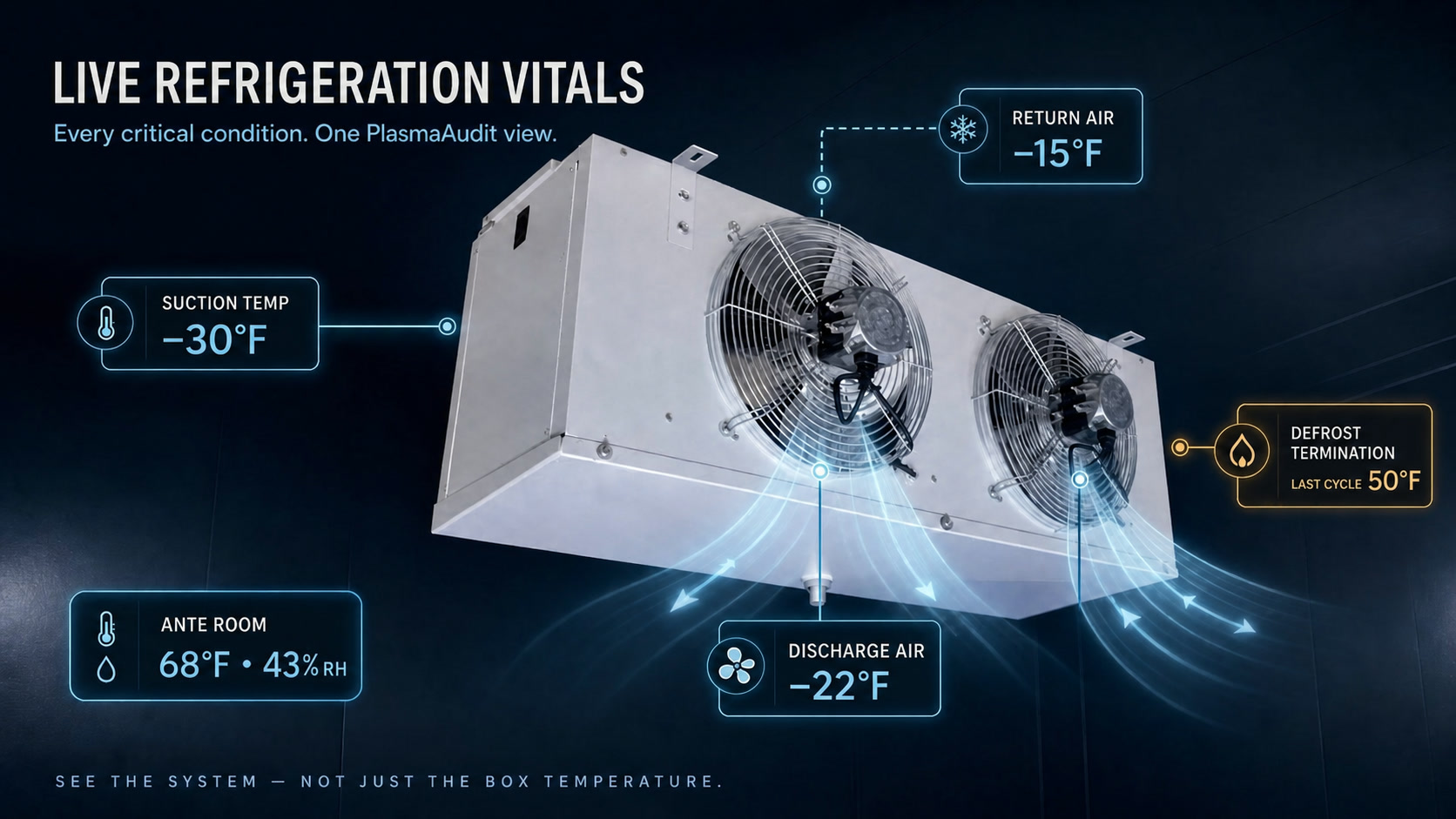
A brief explanation can replace a long diagnostic hunt.

Condensing unit with data points showing refrigeration health context
Pressure contextSee the refrigerant circuit behind the temperature.
Equipment behaviorConnect compressor, fan, cycle, and runtime signals.
Earlier attentionGive people useful evidence before the emergency call.

See the difference in your own facility

Bring us the question your current monitoring cannot answer.

A walkthrough starts with your real operation, your current visibility, and the decisions your team wants to make sooner.

Request a walkthrough